Doubt shows up when you least expect it. Maybe it’s questioning your decisions at 2 AM, second-guessing your abilities before a big presentation, or feeling disconnected from your faith during tough times.
The products in this list won’t magically erase doubt, but they offer practical tools to work through it, whether you’re struggling with self-doubt, faith doubts, or general uncertainty about your path forward.
You’ll find journals that help you track patterns in your thinking, devotionals that ground you in truth when feelings overwhelm facts, wearable reminders that keep encouraging words close, and books that reframe how you think about doubt itself. Some products work best for building spiritual faith, while others tackle confidence and decision-making.
The key differences come down to whether you want something interactive (like workbooks), passive (like jewelry), or structured (like devotionals).
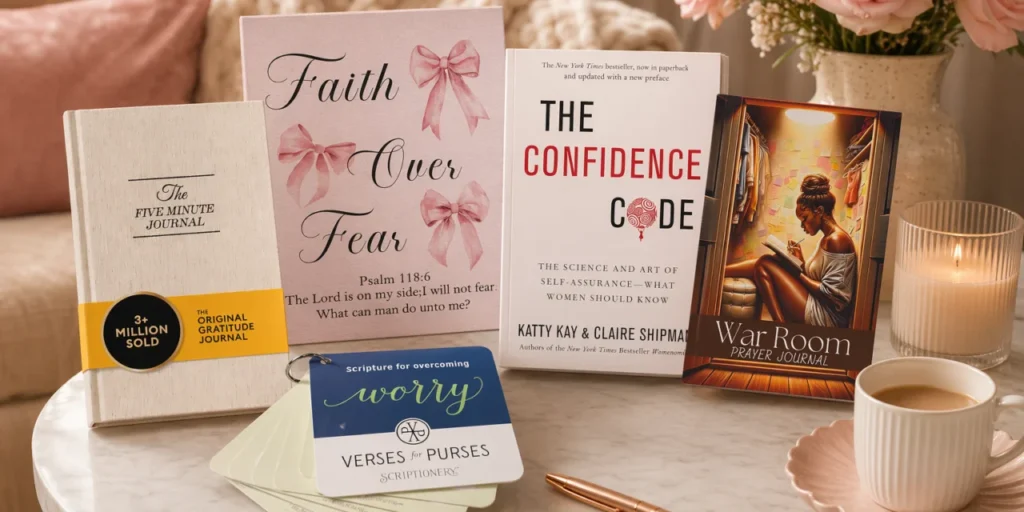
1. “The Confidence Code” by Katty Kay and Claire Shipman
This book breaks down the science of confidence and why women especially struggle with self-doubt. The authors mix research with real stories and actionable strategies to build confidence through action as opposed to waiting to “feel” ready.
It’s particularly helpful if you tend to overthink decisions or compare yourself to others.

2. War Room Prayer Journal
Inspired by the film “War Room,” this guided journal gives you space to write out prayers, track answers, and document your progress through doubt. Each page includes prompts and scripture references to help you move from worried thoughts to focused prayer.
The hardcover binding means it holds up well to daily use, and the structure keeps you from staring at blank pages wondering what to write.

3. “Daring Greatly” by Brené Brown
Brené Brown’s research on vulnerability shows how perfectionism and shame fuel doubt, and why embracing imperfection actually builds resilience. The book reads like a conversation and includes exercises to identify where doubt takes root in your life.
If you struggle with feeling “not good enough” or fear judgment, this one cuts through the noise with both data and heart.

4. Scripture Cards for Anxiety and Fear
This set of 30 scripture cards fits in your pocket or purse and covers specific fears that trigger doubt. Each card has a verse on one side and a short reflection on the other, making them easy to pull out when anxiety spikes during the day.
The laminated finish means they survive being handled repeatedly, and the ring binding keeps them together.

5. The Five Minute Journal
This simple daily journal has you write three gratitudes each morning and reflect on three good things each night. Over time, it rewires your brain to notice what’s working instead of fixating on doubts and problems.
The undated format means you can start anytime, and the structured prompts take less than five minutes, so it’s sustainable even when you’re busy.
6. “Soundtracks” by Jon Acuff
Jon Acuff tackles the repetitive negative thoughts (soundtracks) that loop in your head and offers a practical three-step process to replace them with true, helpful thoughts. The writing is funny and fast-paced, which makes it easier to absorb than dense self-help books.
This works well if your doubt comes from catastrophizing or replaying worst-case scenarios.

7. Faith Over Fear Wall Art Print
This simple canvas print with “Faith Over Fear” in modern typography serves as a daily visual anchor in your home or office. Seeing it repeatedly throughout the day interrupts doubt patterns and redirects focus.
Multiple size options available, and it comes ready to hang without extra framing needed.

8. “Present Over Perfect” by Shauna Niequist
Shauna Niequist writes about letting go of proving yourself and embracing a simpler, more authentic life. The memoir-style chapters show how striving and performing actually increase doubt and disconnection.
It resonates particularly if you’re exhausted from trying to do everything perfectly and still feeling like it’s never enough.

9. Weighted Anxiety Blanket
Physical comfort can calm the body enough that the mind quiets too. This weighted blanket uses gentle pressure to reduce anxiety and help you sleep better when doubt keeps you awake.
Better rest improves decision-making and emotional regulation, which are crucial when working through doubt.

10. “The Ruthless Elimination of Hurry” by John Mark Comer
Constant busyness creates space for doubt to flourish because you never slow down enough to process what’s true. This book makes the case for slowing your life down and includes practical disciplines like silence, solitude, and Sabbath.
If your doubt stems from feeling overwhelmed or disconnected from God, this reframes your entire approach to daily life.

11. Affirmation Card Deck for Self-Esteem
This deck of 52 affirmation cards let’s you pull one each morning for a targeted confidence boost. Each card has an affirmation on front and a journal prompt or action step on back.
The variety keeps it from getting stale, and the portable box fits in a desk drawer or nightstand for easy daily access.

12. “Get Out of Your Head” by Jennie Allen
Jennie Allen addresses destructive thought patterns from a Christian perspective and offers a biblical framework for taking thoughts captive. The book includes personal stories, brain science, and practical steps to interrupt spiral thinking.
It’s particularly helpful if your doubt connects to spiritual warfare or feeling stuck in negative mental loops.

13. “The Gifts of Imperfection” by Brené Brown
Brené Brown’s earlier book focuses specifically on letting go of who you think you should be and embracing who you are. The ten guideposts cover everything from cultivating self-compassion to letting go of comparison.
It’s a gentle read that gives permission to be imperfect, which directly counters the doubt that whispers you’re not measuring up.

14. Essential Oil Diffuser with Calming Oils
Creating a calming physical environment helps quiet anxious thoughts that fuel doubt. This diffuser comes with lavender, chamomile, and frankincense oils known for reducing stress.
Using it during morning devotions, prayer time, or before bed creates a sensory anchor that signals your brain to shift from worry to peace.

15. “Uninvited” by Lysa TerKeurst
Lysa TerKeurst writes about rejection and feeling left out, which often triggers deep doubt about your worth and belonging. She combines vulnerable personal stories with biblical truth about your identity in Christ.
This book particularly helps if your doubt connects to relationships, social anxiety, or feeling like you don’t fit in.

Frequently Asked Questions
Can products really help with deep-seated doubt, or is this just buying stuff to feel better?
Products alone won’t fix doubt, but they can provide structure and reminders that support the actual work of changing thought patterns. A journal creates space to process thoughts instead of letting them loop endlessly.
Scripture cards interrupt anxiety spirals with truth.
Books offer frameworks and language for problems that feel too big to tackle alone. Think of these as tools that make the work more doable, not magic fixes.
The key is actually using them consistently as opposed to collecting them and hoping they work passively.
How do I know if my doubt is normal or if I need professional help?
If doubt interferes with daily functioning, keeps you from sleeping regularly, prevents you from making necessary decisions for weeks or months, or comes with thoughts of self-harm, you need to talk to a therapist or counselor. Products and self-help strategies work well for garden-variety doubt and uncertainty, but clinical anxiety or depression needs professional support.
A good rule of thumb is this: if you’ve tried many strategies for 4-6 weeks with zero improvement, or if doubt is getting worse instead of better, schedule an appointment with a mental health professional.
Which type of product works fastest when doubt hits suddenly?
Physical items you can touch or wear (jewelry, scripture cards, weighted blankets) tend to provide the quickest relief because they engage your senses and interrupt the thought spiral. Keep scripture cards in your car, wear a reminder bracelet, or wrap up in a weighted blanket when anxiety peaks.
These won’t solve underlying issues, but they can calm your nervous system enough that you can think more clearly and choose a next step.
Do I need faith-based products, or will secular self-help tools work just as well?
It depends on the source of your doubt. If you’re questioning your faith specifically or your doubt connects to feeling distant from God, faith-based products (devotionals, scripture cards, Christian books) address that directly.
If your doubt is more about self-confidence, decisions, or general anxiety, secular tools like “The Confidence Code” or “Daring Greatly” might resonate more.
Many people use a mix of both. The important thing is choosing products that align with your actual beliefs as opposed to what you think you “should” use.
How many of these products should I buy to see results?
Start with one or two maximum. Buying a bunch of journals, books, and tools all at once usually leads to none of them getting used consistently.
Pick one book that addresses your specific type of doubt, or one journal if you process better by writing, or one wearable reminder if you need something physical.
Use it daily for at least three weeks before adding anything else. Consistency with one tool beats sporadic use of five different tools.
What if I buy something and it doesn’t help?
Not every product works for every person, and that’s completely normal. If a journal’s prompts don’t fit how you think, or a book’s approach doesn’t click, try something different.
Most Amazon products have return windows, so you’re not stuck with something that doesn’t serve you.
The act of trying different approaches also teaches you about how you personally process doubt, which is valuable information even when a specific product doesn’t work.
Can these products help with doubt about specific situations, like career changes or relationship decisions?
Yes, though some work better than others for situational doubt. Books like “Soundtracks” and journals like The Five Minute Journal help you think more clearly about any situation.
Devotionals and scripture cards ground you in truth when you’re facing big decisions.
The key is using them to process your specific situation as opposed to looking for them to make the decision for you. Write about the actual choice you’re facing, apply the frameworks from books to your real circumstances, and use prayer journals to work through the decision with God.
They’re tools for thinking better, not substitutes for thinking.
Find out our Recommended products for Mental Health and Faith; visit: https://illuminatedresources.com/mental-health-and-faith-a-powerful-duo/